
58%.
We looked at about 700 US credit unions with $500 million or more in assets. Fifty-eight percent had no refer-a-friend program.1
The smaller the credit union, the more likely it has none. At $500 million to $1 billion in assets, 63% had none (175 of 279). At $5 billion to $10 billion, it was 41% (24 of 59).
When we talk with credit unions about referral programs, we hear the same four reasons. Each one shows up in the data.
1. "It costs too much per member"
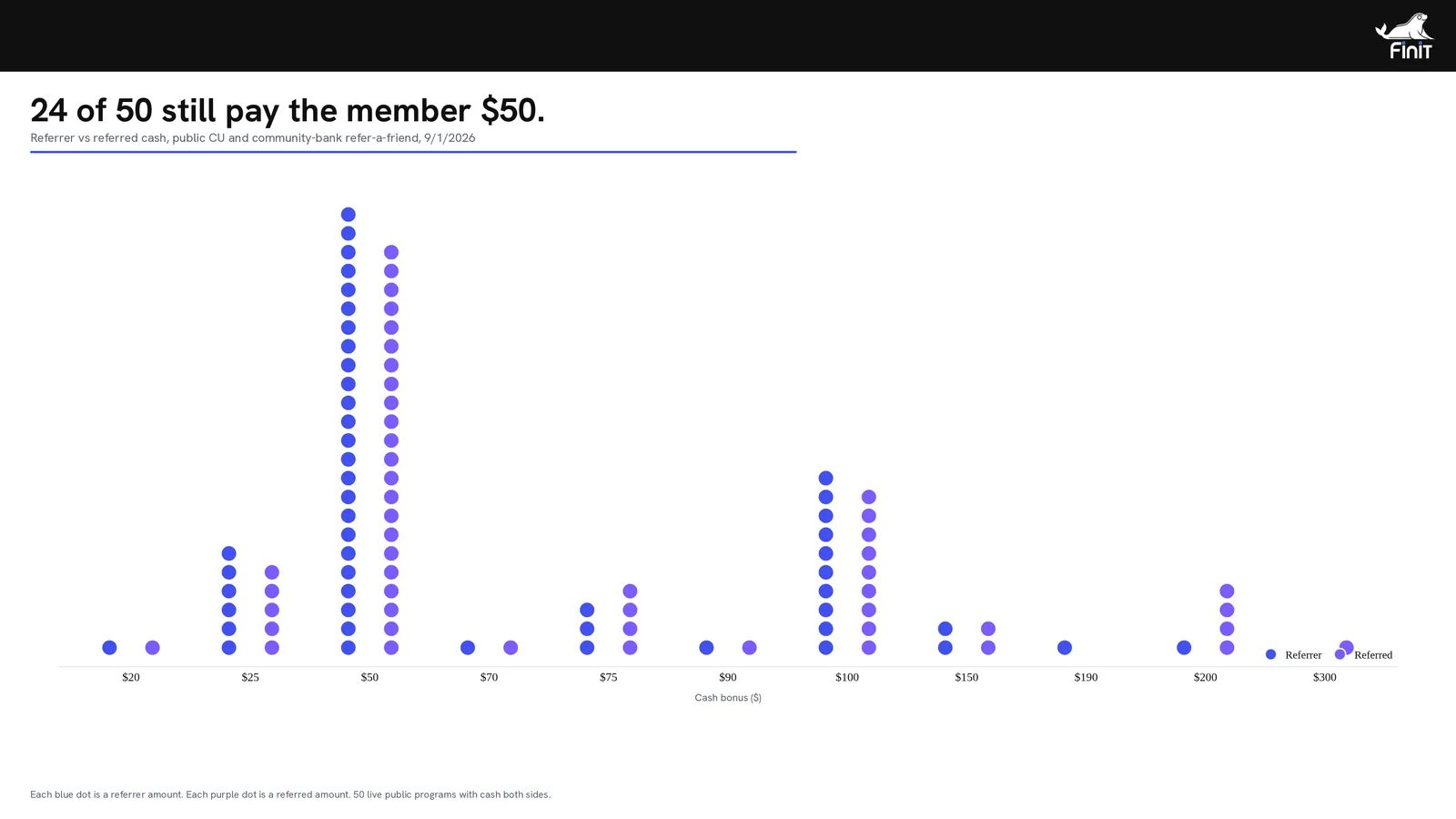
A typical program pays $50 to each side. That's the median of 47 credit union and bank programs that pay cash both ways.2
So a referral costs about $100 per new member. Acquiring a checking customer costs $559.3
That $100 is only the bonus, though. It isn't the full cost of running a program. The rest of the cost is in the next three reasons.
2. "Someone has to check every referral"
Forty-three of the 47 programs require a new checking account. Thirty-eight also require direct deposit or debit card use within 60 to 90 days. Twenty-seven cap what one referrer can earn each year.2
Every rule is a check your staff has to run.
In 22 of the 47 programs, the referral itself is tracked by hand: a printed card, a form, or a promo code. Then someone has to match it to the new account.
On demos, teams tell us it's too manual. Some have had full-time staff watching referrals and payouts. It's tedious work, and it pulls people away from the marketing that actually grows the credit union.
3. "Paying it out is a project"
Twenty-six programs post a payout timeline. Twenty-four of them pay two weeks or more after the member qualifies, most often four to six weeks. From account opening to payout can take three to five months.2
Then there are the rules.
A new member's bonus worth more than $10 is a bonus under Truth in Savings: Regulation DD (12 CFR 1030) for banks and NCUA Part 707 for credit unions. The IRS treats it as interest (Publication 550), reported on a 1099-INT at $10 or more.4
The referrer's reward is different. It is not a Truth in Savings bonus, according to America's Credit Unions compliance guidance, and the tax form for it varies.5 Of 40 program pages that mention tax, at least 9 say 1099-INT, 5 say 1099-MISC, and 5 say either. Check with your tax adviser.
One referral. Two payments. Two sets of rules.
And it doesn't end at payout. Ten of the 47 programs require the account to stay open for a set time. Three take back a bonus that was already paid.
4. "Members never see it"
We found 294 programs at credit unions over $500 million.
Eighty-five percent of them run on a web form, on paper, or on a separate site (251 of 294). We could confirm only 2 inside digital banking.1
Your members already bank in your app. A flyer sends them somewhere else.
One more gap: one bonus for every member
Most programs pay one flat amount. Only 5 of the 47 pay differently by product. None pay differently based on who the member is.2
That leaves value on the table.
Curinos found that customers who hold only a CD renew 70% to 88% of the time, compared with 88% to 94% for multi-product customers.3 And in a Journal of Marketing study of about 10,000 customers at a German bank, referred customers were worth about 16% more and churned about 18% less.6
A payroll checking member, a CD rate shopper, and a new-to-bank member are each worth a different offer.
How FinIT solves it
Accounts get opened on the trust of a friend. When we looked, nothing brought that trust inside digital banking. So we built it.
FinIT Refer is a white-labeled referral program built to answer each reason:
- Cost per member. Marketers launch and adjust referral and promo offers themselves, without waiting on IT.
- Checking every referral. FinIT handles qualifying and payout end to end, with no added headcount, so your team gets back to marketing.
- Paying it out. Payout is part of that same end-to-end design. Disclosure and tax decisions stay with your team.
- Members never see it. It runs inside your digital banking, on Q2, Banno, and other platforms. There's no second site.
- One bonus for every member. Run programs side by side and compare what works.
Member data stays with your institution. More than 20 financial institutions work with FinIT. We want every FI to be able to run a referral program that works.
Let's compare notes
If member growth sits with your team, we'd be glad to walk through it. Book 30 minutes or see how FinIT Refer works.
For what programs pay today, read Today's refer-a-friend reality.
1 FinIT review of about 700 US credit unions with $500 million or more in assets.
2 FinIT review of 47 credit union and bank refer-a-friend programs that pay cash to both sides.
3 Curinos, 2025.
4 12 CFR 1030 (Regulation DD); NCUA 12 CFR Part 707; IRS Publication 550; IRS Instructions for Form 1099-INT.
5 America's Credit Unions compliance guidance.
6 Schmitt, Skiera, and Van den Bulte, "Referral Programs and Customer Value," Journal of Marketing, 2011.
See what a referral program would return at your numbers with our credit union referral calculator.