I keep getting asked what a competitive refer-a-friend looks like right now. So we counted.
We pulled 50 public credit union and community-bank refer-a-friend pages that pay cash on both sides. Forty-one are credit unions. Nine are community banks.
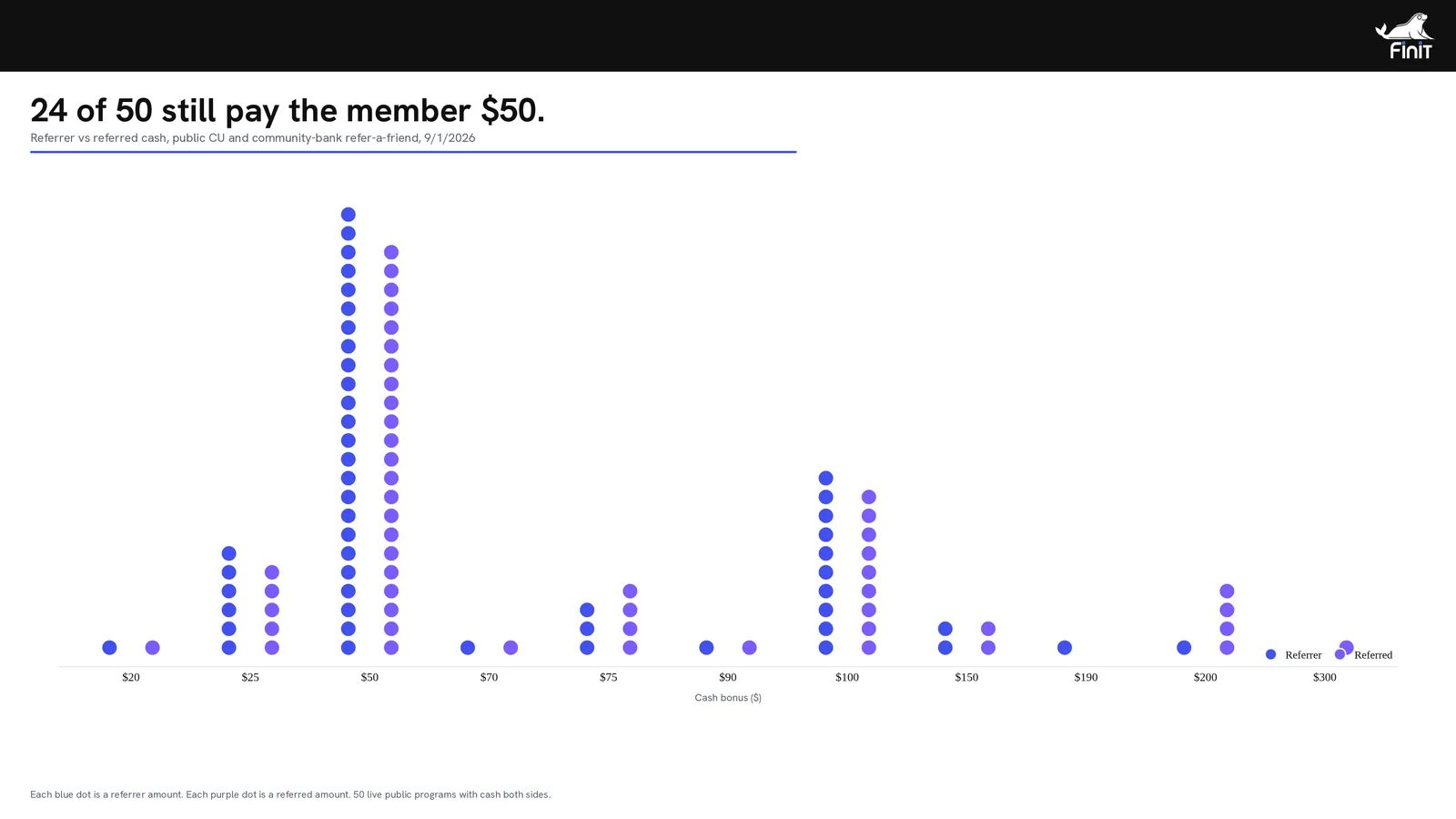
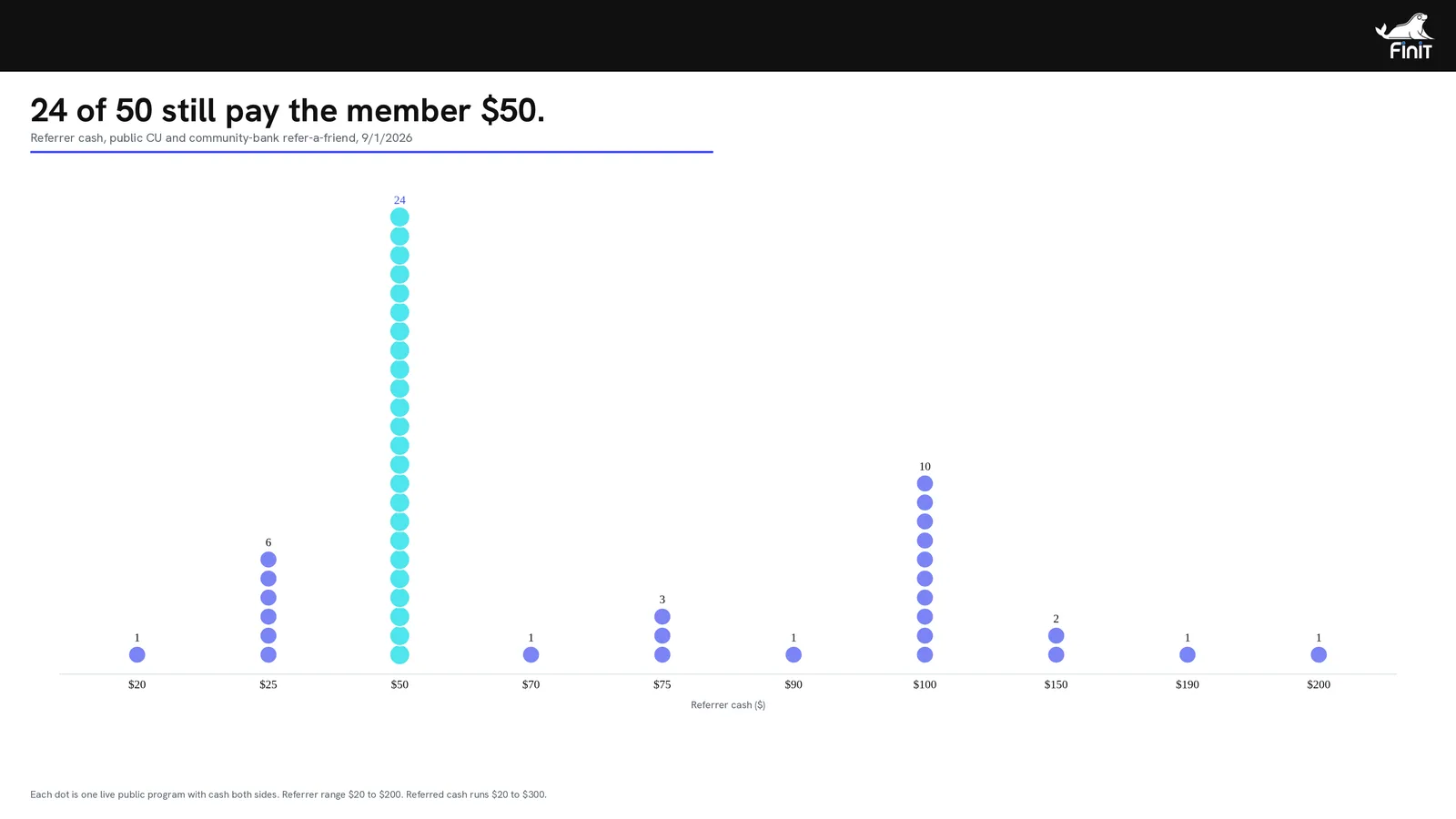
Cash to the member runs $20 to $200. Cash to the friend runs $20 to $300.1
Twenty-four of those 50 still pay the member $50. Twenty-one pay $50 to both sides. Forty-two pay the same amount both ways.
That $50 pile is real. It is not the whole market.
Ten programs pay the member $100. Six pay $25. A few print $70, $75, $90, $150, $190, or $200. One program pays the friend $300.
Eight of the 50 pay different amounts each way. The rest keep it even. These are not abstractions. They are what members see in the app, on a flyer, or on a branch poster this fall. For the teams that run these programs, the dollar is the easy part.
The gap: the number is not the program
Most of the pages we read lead with cash. The work is in the gate.
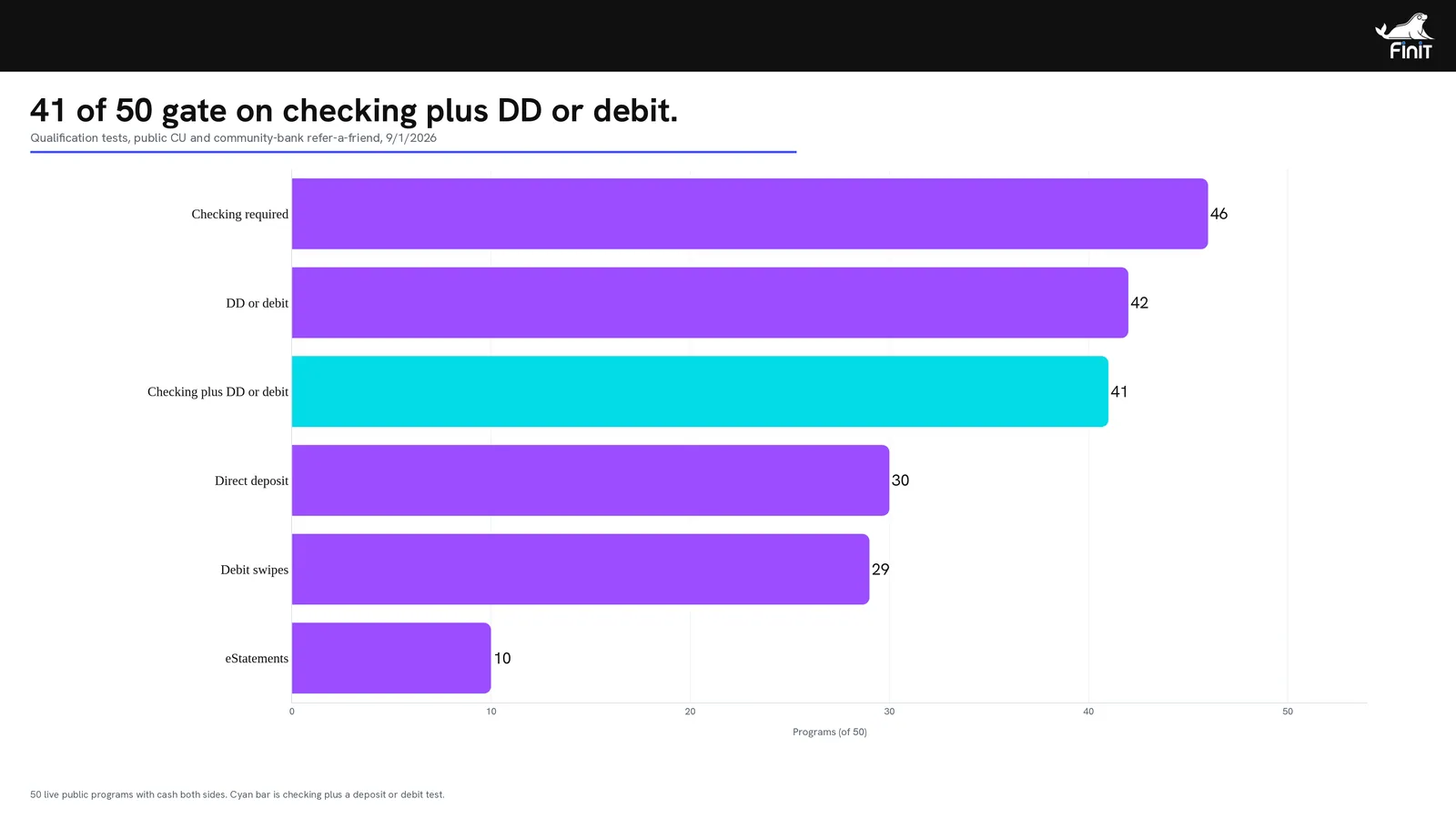
Forty-six of the 50 require a new checking account. Forty-two require a direct deposit, debit activity, or both. Forty-one stack new checking on top of that deposit or debit test. Ten also require eStatements.1
The window is usually 60 to 90 days. Thirty-seven of the 50 have no public end date. Thirteen are running to a campaign date.
That is the knowledge gap. Members see $50 or $100. They do not see that the offer is really "open checking, then fund it, then use it." Growth teams already know this. Public pages still bury it.
24 of 50 still pay the member $50.
The silver lining is that the programs are alive. Credit unions and community banks are paying cash, and members are using them. The opportunity is not to throw out a working idea. It is to make the idea easier to run, easier to change, and easier for a member to finish.
A few that are in market right now:
- IU Credit Union, $70 / $70 through 12/31, with recurring direct deposit of $300 or more.
- America's Credit Union, $75 / $75. The member is paid when the checking opens. The friend is paid after $100 or more in direct deposit within 60 days.
- BMI Federal Credit Union, $100 / $200 through 9/30, with checking, 30 debit purchases, and eStatements in 90 days.
- Oregon State Credit Union, $100 / $300, with recurring direct deposit of $500 or more per month in 60 days.
- Provident Credit Union, $150 to the member, $50 to the friend.
The spread is the point. If you are rewriting for next year, start with the gate, not the number.
How growth teams can use this
Start with the gate
Decide what a good new account looks like at your shop. Then write the cash around that.
If you want payroll, require a recurring deposit. If you want debit activity, require swipes. If you want paper out of the mail, require eStatements. The 50-program scan shows you can stack those tests. It also shows you do not have to.
The teams that get more from refer-a-friend are not always the ones paying more. They are the ones whose qualification matches the accounts they actually want to book.
Put the invite where members already are
September is the invite month.
That is not a slogan. It is what we saw in our own volume last year. Top invites in September. Top joins in October. The fall surge is real.2
Twenty-eight of the 50 programs already live in-app. Twelve still ask the member to print and bring a form. Seven are hybrid. Three are a simple web form.
Members are already in digital banking. The invite that lives in-session gets used. The invite that lives on a PDF in a branch drawer gets used less.
You do not have to dunk on paper. Paper still works at some shops. Digital just lets you hit the whole membership without a campaign calendar doing all the work.
Pay cash both ways, automatically
Cash into both accounts is the structure most of these 50 programs already use. Forty-two pay the same amount to each side. Members understand it. Friends understand it.
The operational question is how the money moves. Files, gift cards, and manual credits all work until volume shows up. Direct deposit of cash by ACH into the referrer and the referred accounts is the version that still works when you have more than a handful of claims.
Meet FinIT Refer
FinIT Refer is how we run this for credit unions and community banks.
We connect to the core. Qualifying events (checking open, deposits, debit, eStatements) are read from the institution, not typed in from a spreadsheet. Cash lands in both accounts by ACH. The program sits in digital banking, so the member does not leave the session to refer. See how it works.
We are a US team in Austin. We work with credit unions from a few thousand members to a few hundred thousand. The average client books millions of dollars of deposits through the platform. At some shops, referrals are about 15% of new accounts.3
You can still set the dollar. You can still set the gate. You can change either without rebuilding the program.
What working looks like
Public Employees Credit Union launched FinIT Refer in Q2 digital banking. Scott Murphy, VP of Marketing, had the program in front of the whole membership in a week.
"PECU studied many types of refer-a-friend programs and we felt like Finit has the best product. The whole program is now available right in our mobile app."
In the first month they saw a 20% increase in new checking openings.4
That is the job. Not a bigger headline number. A program members can finish, and a team that is not stuck in the files.
Ready to rewrite the gate?
The current number is not one number. $50 is still the pile. $100 is the next shelf. $20 to $300 is the live range.
If you are planning next year's refer-a-friend, we will show you the platform and the incentive rules that have actually booked. Worth 20 minutes?
1 FinIT scan of 50 live public credit union and community-bank refer-a-friend programs that pay cash on both sides. Pages fetched August 28, 2026. Named examples skip expired public pages.
2 FinIT internal invite and join volume, calendar year 2025. Top invites in September. Top joins in October.
3 FinIT client results. Average clients earn millions of dollars of deposits on the platform. Referrals drive about 15% of new accounts at some shops.
4 PECU: A Simpler Referral Program, finitloyalty.com/blog/pecu-case-study. Scott Murphy, VP of Marketing, PECU.
Want to know what your institution can afford to pay? Use the credit union referral calculator or the bank referral ROI calculator.