58% of credit unions over $500M have no referral program we could find on their public site.
Our last post looked at why. Two reasons kept coming up.
Someone has to check every referral. Someone has to pay it out safely.
Neither is a marketing problem. Both live in the back office. That's why they get skipped.
The rules are already standard
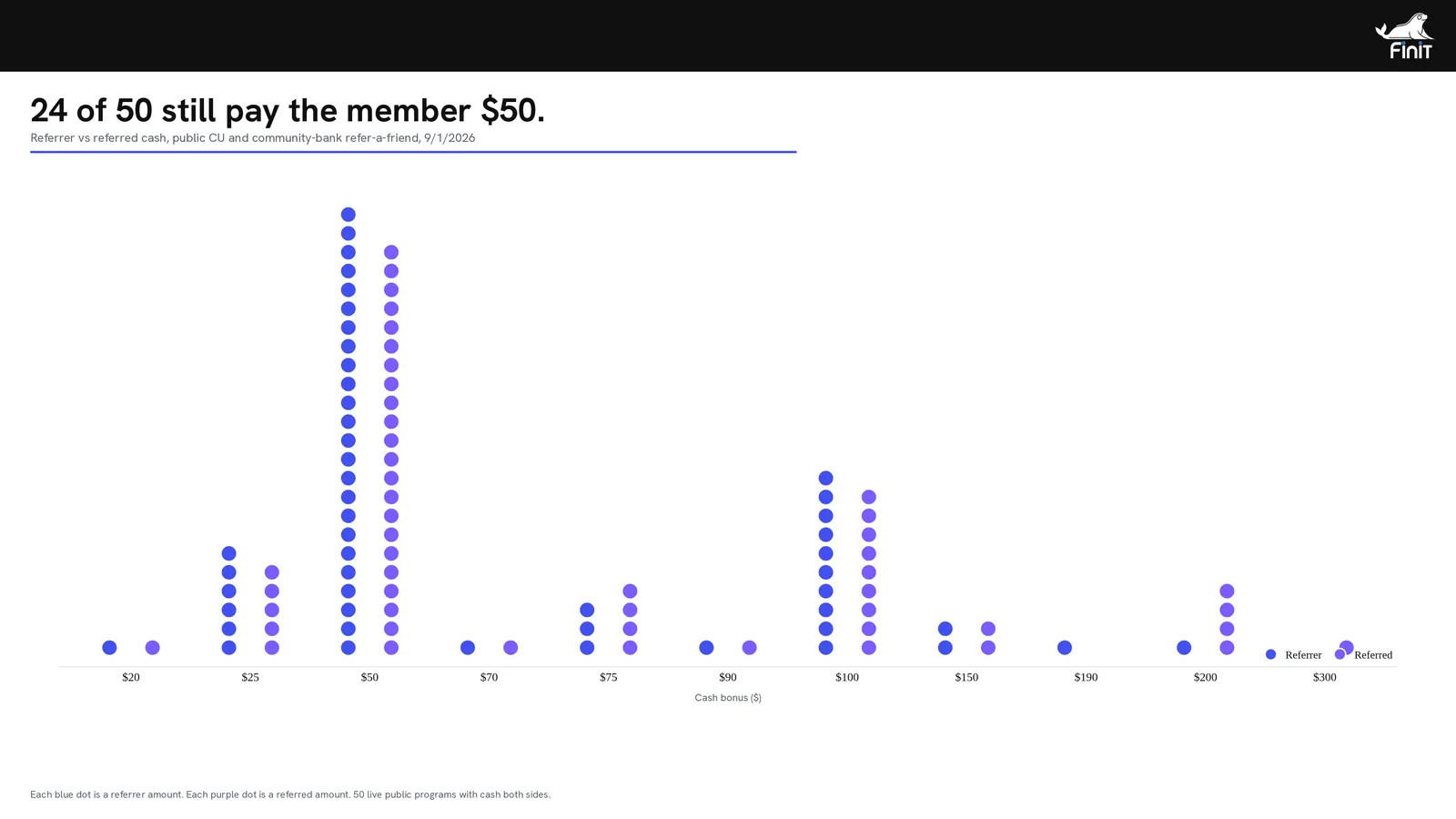
We reviewed 50 public refer-a-friend programs at credit unions and banks. Their rules look a lot alike.
46 of 50 require a new checking account. 42 of 50 require direct deposit or debit card use. Most give the new account 60 to 90 days to qualify.
FinIT scan of 50 programs, Today's refer-a-friend reality
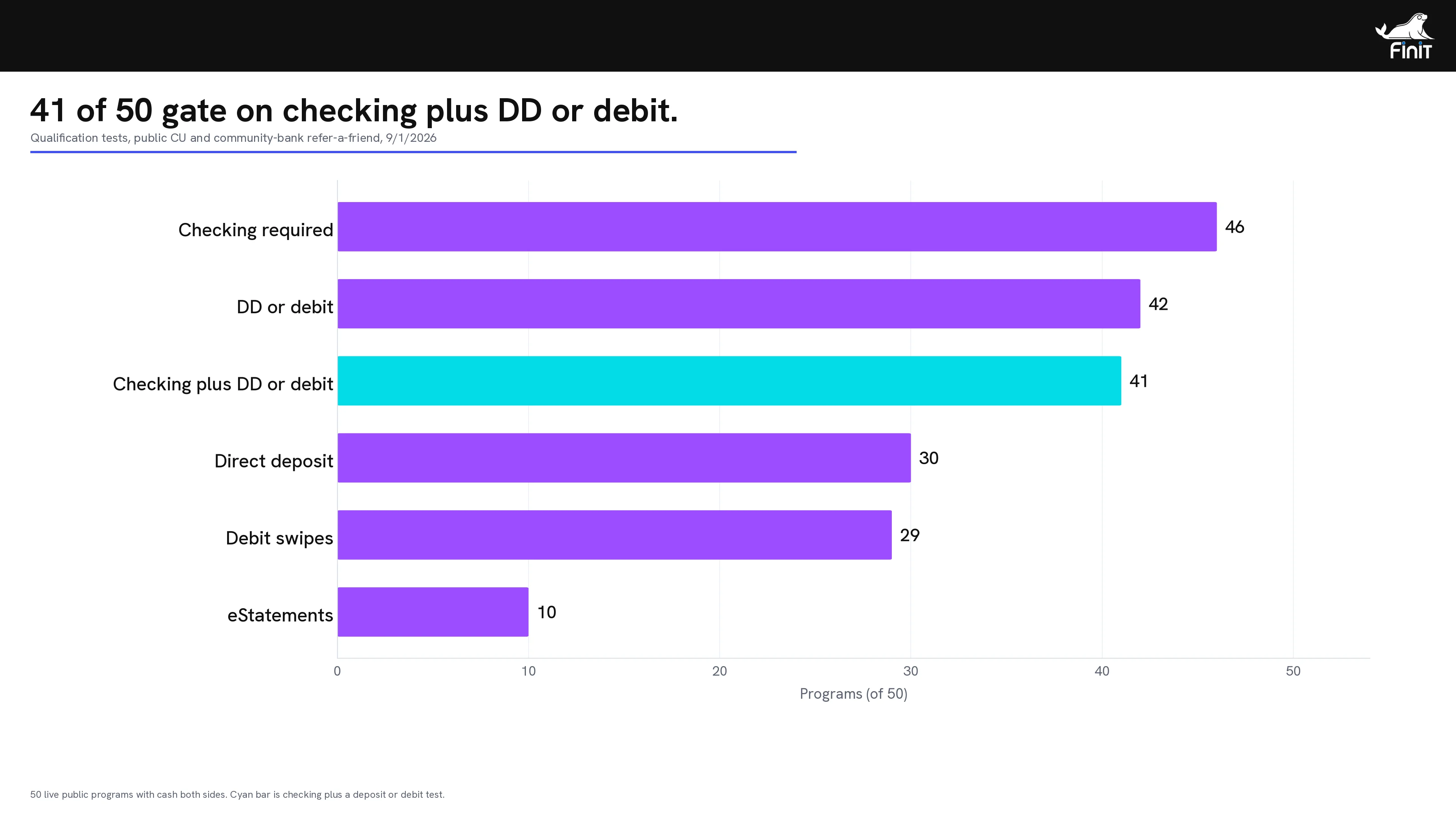
Writing the rules isn't the hard part. Checking them is: account by account, for 60 to 90 days.
That's where staff time goes.
Every step below can run on rules your core and digital banking data already support.
1. Write rules a system can check
Every rule should be something your data can confirm. No judgment calls.
- New account. A new checking account, opened by someone who wasn't already a member or customer.
- Funded activity. A direct deposit, or a set number of debit card swipes.
- A clear window. Pick one, such as 60 or 90 days from opening. State it plainly.
- Good standing. Both accounts open and current when the reward pays.
If a person has to read a form to confirm a rule, rewrite the rule.
2. Build fraud checks into the rules
Referral fraud usually shows up two ways: the same person on both sides, or one referrer with a burst of thin accounts.
These checks catch both:
- Match on identity, not just name. Flag shared addresses, phones, emails or devices across referrer and new account.
- Require real activity. A funded deposit or card use is harder to fake than an opened account.
- Cap rewards per referrer. An annual limit stops one bad actor from scaling.
- Hold until qualified. Never pay at account opening.
Flags land in a short review queue. Clean referrals move on untouched.
3. Pay rewards by ACH
Payout is where many programs stall. Staff key credits by hand, in batches, sometimes weeks after the member qualified.
ACH payout cuts that step. A referral clears the rules, and the reward goes straight to the account.
Settle two things with your compliance team up front:
- How the bonus is disclosed under Regulation DD for banks or NCUA Part 707 for credit unions.
- How rewards are tracked for year-end tax reporting. Referral rewards may count as reportable income, so confirm the treatment with your institution's tax advisor.
4. Know what a referral costs per new account
Everyone sees the bonus. It isn't the full cost.
Count it this way:
Cost per new account = (rewards paid + staff time + tools) ÷ qualified new accounts
Most teams leave out staff time. Hours spent matching forms, checking deposits and keying payouts belong in the math.
Push that line to near zero and the cost becomes mostly the reward itself. Then compare it to what your other channels spend to open a funded account.
Where FinIT Refer fits
FinIT Refer runs all four steps inside digital banking.
Members and customers refer from the app they already use. FinIT tracks new accounts, direct deposits, card swipes and e-statement enrollment against your rules. Rewards pay by ACH. Your team watches it all on a live dashboard.
FinIT handles qualifying and payout end to end, with no added headcount.
It's white-label, plugs into Q2 and comes with US support. Credit unions and banks including OMNI, Community 1st, Stock Yards and Bravera are among 20+ institutions working with FinIT.
Start with the rules you already have
You don't need a new hire to run a referral program. You need rules a system can check and a payout that runs itself.
See how that works for your institution. Book a 30-minute walkthrough.